
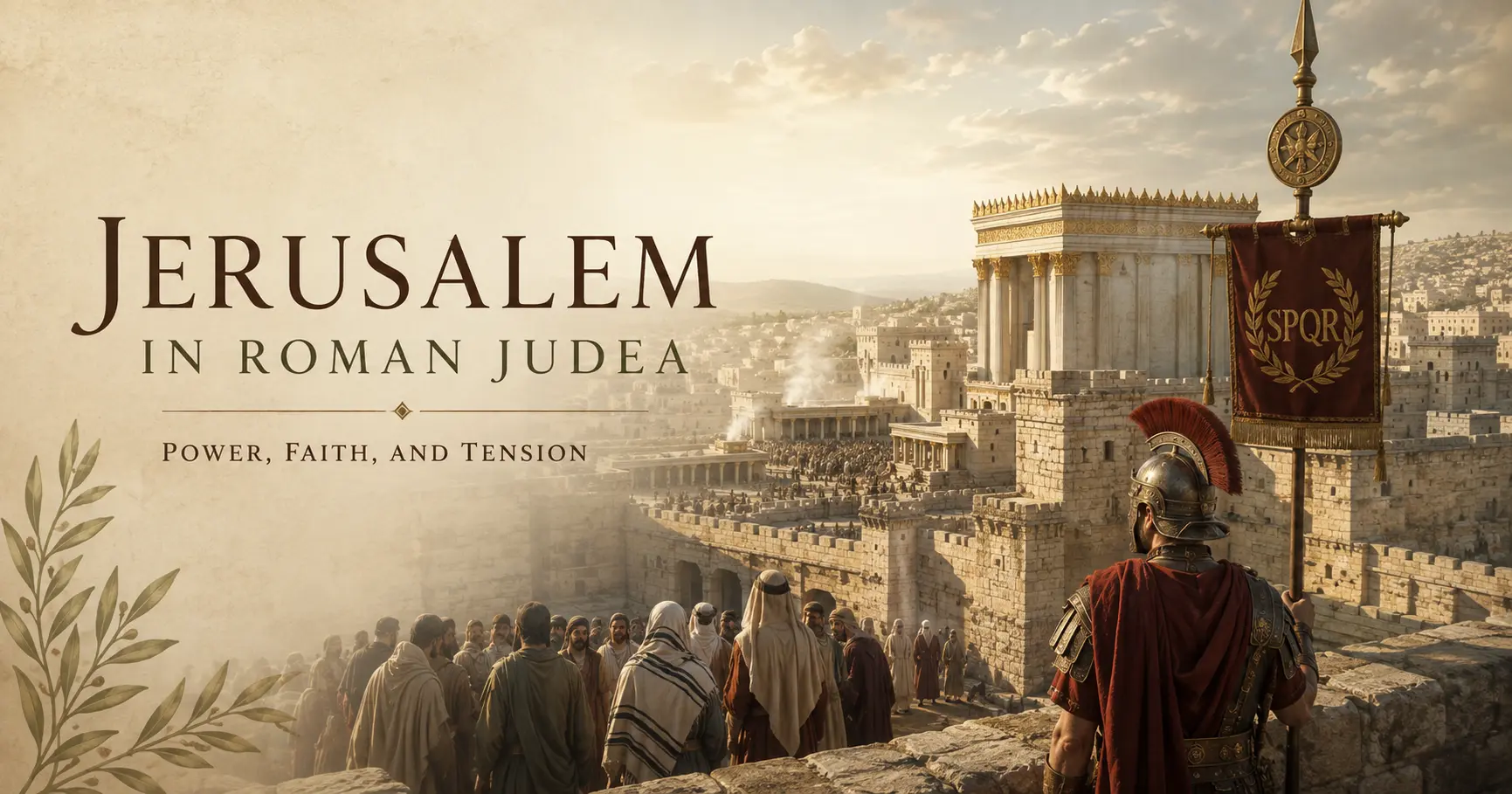
Jerusalem was not just an ordinary city under Roman rule.
It was the center of Jewish worship, home to the Temple, and the place where religion, politics, and national identity all met. Rome could send soldiers and appoint officials, but it could not easily control what Jerusalem meant to the Jewish people.
This made the city hard to govern and, in the eyes of Roman authorities, dangerous.
Rome Took Jerusalem by Force
Roman control started in 63 BCE, when General Pompey entered Jewish lands and attacked Jerusalem. His troops surrounded the city, cut off supplies, and eventually broke through its defenses. Jewish independence ended, and Rome took over the region.
The conquest had a lasting impact. Rome entered the Temple, interfered with its finances, and gave political power to leaders who answered to the empire.
Jerusalem remained the spiritual center of Jewish life, but it now stood under foreign control. That tension never fully disappeared.
The Temple Carried Political Weight
The Temple was a place of worship, but it was also tied to leadership, money, and public authority. Rome understood that very well.
Control around the Temple gave the empire influence over Jerusalem. According to the manuscript, Roman rulers weakened the traditional priesthood and replaced independent religious leaders with men who could be pressured or controlled.
Many people still revered the Temple, even when they distrusted those who managed it. That created a tense situation. A dispute in the Temple could quickly become a wider political problem.
Jesus’ actions there, including overturning the money changers’ tables, would not have looked like a private religious protest. They happened in the most sensitive place in the city, where Roman authority and Jewish identity met.
Passover Made Jerusalem Harder to Control
Passover brought huge crowds into Jerusalem. Pilgrims arrived from across Jewish lands to remember the freedom of their ancestors from slavery in Egypt.
Under Roman occupation, that memory carried obvious political force.
The festival celebrated liberation while Roman troops stood nearby. Rome knew how quickly that could turn into unrest.
The book describes Passover as a period when insurrection attempts had happened before. Groups of young men gathered in Jerusalem hoping to challenge Roman rule. Most of those efforts failed, but Rome never treated them lightly.
A crowd could change in minutes. One speech, one confrontation, or one popular leader could shift the mood of the whole city.
Pilate Prepared for Trouble
Pontius Pilate did not treat Jerusalem like a quiet religious center. He treated it like a possible site of rebellion.
The book states that he placed thousands of soldiers in Jerusalem and kept more troops ready in Caesarea. That level of preparation shows how seriously Rome viewed Passover.
Pilate’s job was simple on paper: keep order. In practice, that meant watching crowds, controlling public movements, and acting quickly when someone appeared capable of inspiring resistance.
A failure in Jerusalem could damage his position with Emperor Tiberius. He had every reason to be cautious, and every reason to remove a figure who seemed politically dangerous.
Jesus Entered the City at the Worst Time for Rome
Jesus arrived in Jerusalem during Passover, surrounded by followers and public attention.
The book presents him and his disciples as part of the Zealot freedom movement. It argues that Rome viewed Jesus as the Spiritual Leader of the Zealots and feared the influence he might have over the people.
Several details would have concerned Roman officials:
- He entered during a festival centered on freedom.
- Crowds gathered around him.
- He moved toward the Temple.
- He challenged Roman taxation.
- People connected him with messianic hope.
That combination was enough to attract attention.
The title, “Messiah,” meaning “Savior” or “King of the Jews made the situation even more serious. Rome did not allow independent kings in Judea unless Caesar approved them. A popular man linked to kingship, freedom, and public support could easily be seen as a threat.
Jerusalem Gave Every Movement a Larger Meaning
Galilee had a long history of resistance, but Jerusalem gave any movement a national stage.
A teacher might gather followers elsewhere without causing immediate alarm. In Jerusalem, during Passover, the same crowd could look like the beginning of an uprising.
That was what made the city so sensitive. Jerusalem brought together faith, memory, politics, and public emotion in one place. Rome watched it closely because it knew how quickly those forces could turn against imperial rule.
In Jesus The Holy Zealot, Jerusalem becomes the point where Rome’s fear of rebellion meets Jesus’ role in the freedom movement. The city was sacred to the Jewish people, but to Rome it was the place where trouble could spread fastest.
The final days of Jesus unfolded there for a reason.