
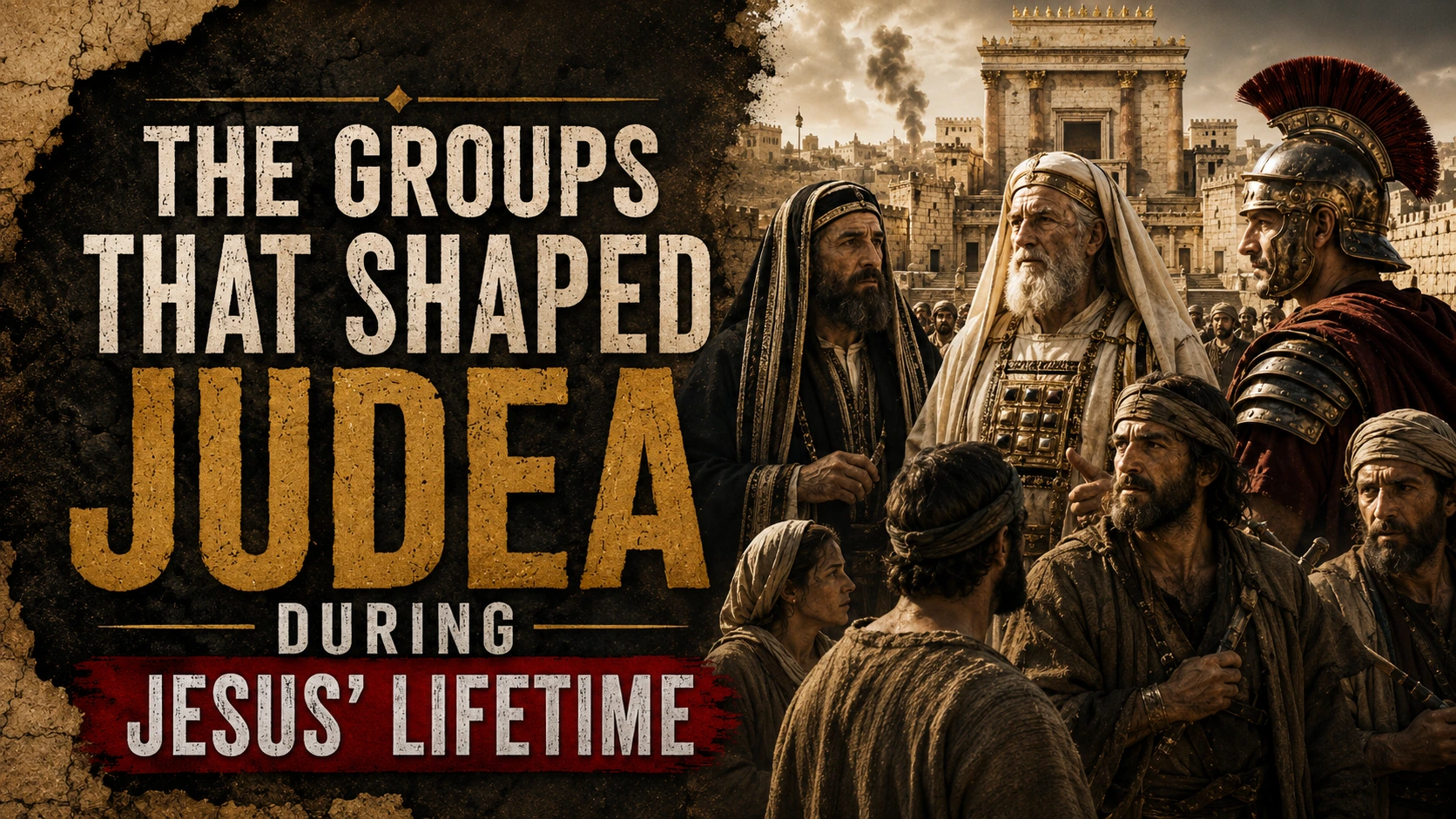
Long before the destruction of Jerusalem or the spread of Christianity, Judea was already a divided land.
These disagreements were significant and affected nearly every part of daily life. People argued over religion, politics, Roman rule, and the future of the Jewish nation. Some thought cooperation was the best way to survive. Others believed only armed resistance could restore Israel. There were also those who chose to withdraw from society completely.
Jesus entered that world.
Learning about these different groups helps us better understand the world of the Gospels. It also shows that first-century Judea was much more politically complicated than it might seem in simple stories.
Judea Was More Than a Province Under Rome
Roman occupation affected every level of Jewish society.
Taxes went to the Roman Empire. Roman soldiers kept order. Local leaders tried to balance Jewish traditions with what Rome wanted, often facing significant pressure.
Not everyone responded in the same way.
Several groups formed, each with its own ideas about what Israel’s future should look like.
| Group | Primary Focus | Position Toward Rome |
| Pharisees | Religious law and tradition | Lived under Roman rule while preserving Jewish identity |
| Sadducees | Temple leadership and priesthood | Worked with Roman authorities to maintain stability |
| Essenes | Religious purity and separation | Withdrew from public society |
| Zealots | National freedom | Rejected Roman rule and encouraged resistance |
These groups often argued with each other just as much as they disagreed with Rome.
The Pharisees Focused on Everyday Faith
People often remember the Pharisees because they appear frequently in the New Testament, but they were more than just a group of religious debaters.
They focused on adhering closely to Jewish law and believed these teachings should be part of daily life, not just in the Temple. Their ideas spread to towns and villages all over Judea, shaping the religious lives of many Jewish families.
While the Gospels often highlight disagreements between Jesus and some Pharisees, they actually agreed on important beliefs, such as the resurrection and the authority of Scripture.
If we focus only on their conflicts, we miss the full story.
The Sadducees Held Power Inside the Temple
The Sadducees, unlike the Pharisees, were tied to the Temple leaders and the priestly upper class.
They had influence because of their positions, not because they were popular.
Keeping things stable was important to them, since unrest could threaten both Roman control and their own power. They often worked with Roman officials to keep the peace, even if other Jewish groups criticized them for it.
They cared more about their responsibilities in the Temple than about starting a revolution.
The Essenes Chose Separation Instead of Resistance
Some people didn’t think it was right to confront Rome directly.
The Essenes chose a different path.
Instead of getting involved in politics, they moved to isolated communities focused on strict discipline, property sharing, and religious purity. Many scholars link them to the settlement at Qumran near the Dead Sea, where the Dead Sea Scrolls were found centuries later.
They dealt with corruption by keeping their distance.
Rather than trying to change society, they got ready for what they believed would be God’s future action.
The Zealots Believed Freedom Could Not Wait
Of all the major groups, the Zealots worried Rome the most.
Their goal was simple: Judea should belong to the Jewish people, and foreign rulers had no right to be there.
Many refused to pay Roman taxes. Some thought fighting back with weapons was not only justified but necessary. For them, national identity and religious beliefs were so closely linked that opposing Rome felt like a moral duty.
Rome quickly saw how dangerous this could be.
Rebellions had challenged Roman power before, so governors across the empire acted fast whenever they saw organized resistance.
This tense political situation is the backdrop for many modern books about Jesus, as it shaped the world in which he lived and taught.
Where Does Jesus Fit Into This Picture?
One reason people still debate about the historical Jesus is that he doesn’t fit neatly into any of these groups.
He debated Pharisees.
He taught in areas where Zealot influence was strong.
He challenged practices connected to the Temple.
He gathered large crowds in public during Roman occupation.
These facts make historians wonder how both Jewish leaders and Roman officials saw Jesus.
Modern scholars look at these questions in different ways. The book Jesus: The Holy Zealot joins the conversation by exploring Jesus in the political world of first-century Judea and seeing him as the Spiritual Leader of the Zealots. Instead of separating his ministry from the conflicts with Rome, the book says these events are key to understanding his life and crucifixion.
Four Groups, One Divided Nation
The Pharisees, Sadducees, Essenes, and Zealots were more than just groups with different religious views.
They each offered a different answer to the same question.
How should the Jewish people live under Roman rule?
Some chose cooperation. Some focused on preserving religious tradition.
Some stepped away from society.
Others are prepared to fight.
By the time Jesus started teaching, these competing ideas had already shaped Judea for many years. The political and religious world described in the Gospels did not appear suddenly. It came from a society that had been struggling with power, identity, and its future long before Rome held another public crucifixion.